


Red Light for TMJ: What the Research Shows and How to Use It Safely
Red light therapy for TMJ means shining low-level red and near-infrared light on the jaw joint and chewing muscles to ease pain and stiffness. Clinical trials have tested it in people with temporomandibular disorders (TMD, the umbrella term for jaw joint and jaw muscle problems), and several found less pain with real light than with a sham device. It works best as one part of a jaw-care plan, not a replacement for a diagnosis. If you want to use it at home, the useful questions are which wavelengths studies used, where the light goes, how often, and who should skip it. Those are answered below.
TL;DR
- Trials of red (about 630 to 670 nm) and near-infrared (about 780 to 905 nm) light on the jaw report pain reduction, and several beat sham treatment.
- Studies place the light over the jaw joint, the masseter (cheek muscle) and the temporalis (temple muscle), usually for 2 to 4 weeks with two to three sessions a week.
- Red light is typically studied alongside exercises or a splint, and the best functional results came from combined approaches.
- Wear eye protection, skip it during pregnancy over the abdomen and over active tumors or infections, and mention photosensitizing medicines to your clinician first.
- Get the jaw problem diagnosed by a dentist or TMD specialist first, so the light is aimed at the right tissue.
Table of Contents
- What TMJ pain is, and why light is used on it
- What clinical trials report
- What the studies used: wavelengths, places and schedules
- How to use red light for TMJ, step by step
- Safety: who should be careful
- Choosing a device for the jaw
- Where we come down
- Bring the routine home
- FAQ
- Sources
What TMJ pain is, and why light is used on it
The temporomandibular joint (TMJ) is the hinge on each side of your head where the lower jaw meets the skull. When people say “TMJ,” they usually mean a disorder of that joint or the muscles that move it: jaw pain, clicking, locking, headaches, trouble opening wide. Clenching, grinding, stress, injury and arthritis can all play a part.
Red light therapy, also called photobiomodulation (PBM) or low-level laser/LED therapy, delivers light that tissue absorbs without heating it significantly. A 2026 clinical review describes it as nonthermal and nonablative, meaning it acts without a meaningful rise in tissue temperature. The idea is that light absorbed by cells supports energy production and calms inflammation. We explain the cell-level mechanism in Photobiomodulation Explained.
The jaw is a good fit for light because the joint and the masseter sit close under the skin, so red and near-infrared wavelengths reach them from outside the face.
What clinical trials report
The evidence is a mix of laser and LED studies, and it is worth reading by what each one actually did.
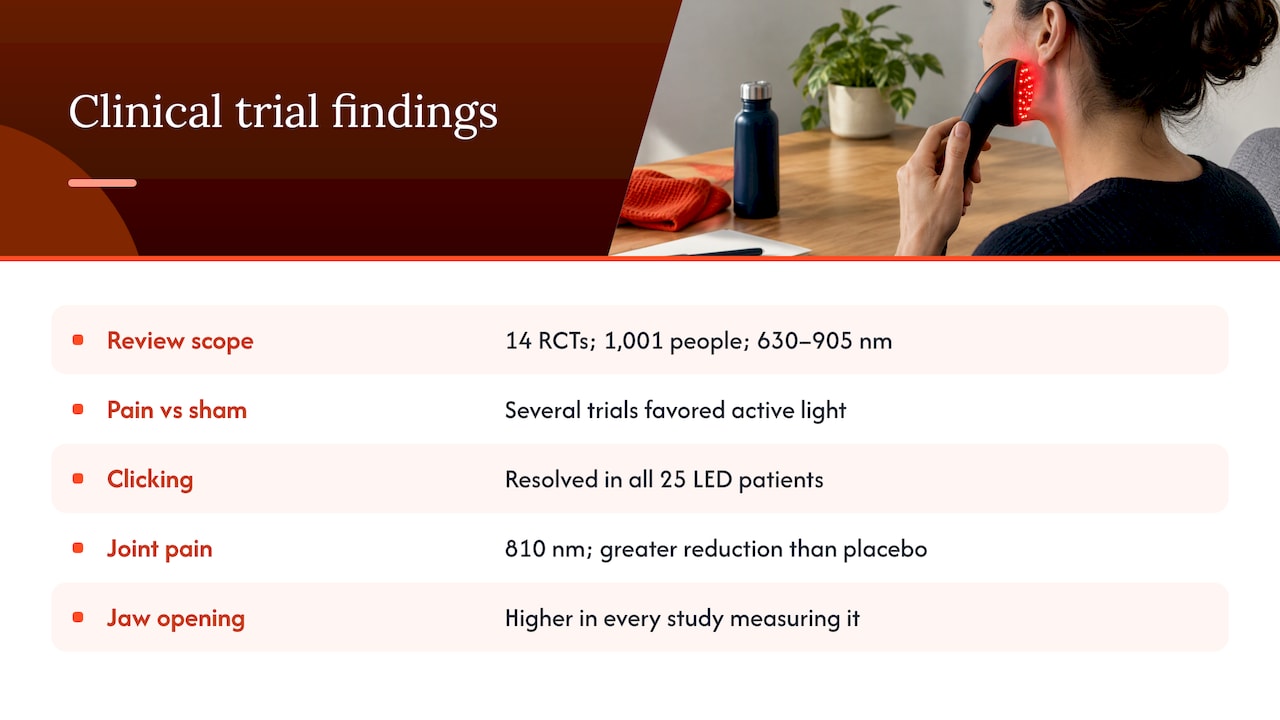
Pain relief against sham. A 2026 systematic review of 14 randomized trials with 1,001 participants, using wavelengths of roughly 630 to 905 nm, found that several trials showed greater pain reduction with active light than with sham. Of the trials that reported adverse events, none reported serious ones.
LED clusters. A 2026 blinded trial used 850 nm infrared and 660 nm red LED clusters over the jaw joint, masseter, temporal, scalene and trapezius muscles across six sessions in two weeks. Pain dropped in the LED group after the course. Another double-blind trial combined 18 red (660 nm) and 18 infrared (850 nm) LEDs, applied three times a week for two weeks, and found pain intensity fell significantly more than in the control group.
Clicking and muscle tenderness. In a 2019 trial of 50 patients with jaw myofascial pain, 660 nm red LED was applied for three minutes per point. Pain and the number of tender muscles improved, and joint clicking resolved in all 25 patients in the LED group.
Joint pain specifically. A randomized, placebo-controlled trial of 175 patients used an 810 nm laser once daily for seven days. Patients with joint pain (arthralgia) had greater pain reduction with light than with placebo.
Jaw opening. A 2023 updated review of 40 studies found that maximum mouth opening, both passive and active, was higher in the light-treated groups in every study that measured it.
A fair reading: the strongest and most consistent signal is for jaw pain, with results varying by TMD type and by how the light was delivered. The 2026 umbrella review of 32 systematic reviews points to one thing that would sharpen the picture: fuller reporting of power density and dose in future trials. That is why the settings below matter.
What the studies used: wavelengths, places and schedules
The published protocols are remarkably similar in spirit, even when the devices differ.
| Element | What studies reported |
|---|---|
| Red wavelengths | 630 to 670 nm (630, 632.8 and 660 nm appear across trials) |
| Near-infrared wavelengths | 780 to 905 nm (780, 810, 830, 850 and 904 nm appear) |
| Where the light goes | Over the jaw joint (about three points around it), masseter, temporalis; some protocols add neck and shoulder muscles |
| Time per spot | 30 seconds to 3 minutes depending on device power |
| Schedule | Twice weekly for 3 to 4 weeks, or three times weekly for 2 weeks (six sessions) |
A 2018 review describes a representative protocol: a 780 nm diode laser at three points per joint, twice a week for three weeks, with muscles treated at a lower dose per point. A comparative trial of 30 patients used red (630 nm) or infrared (850 nm) LEDs for 60 seconds at five facial points, eight sessions over four weeks, and every group saw significant pain reduction and wider mouth opening.
Two things follow for anyone planning home use. First, consistency over a few weeks is the pattern, not a single session. Second, light has to reach the target, so placement over the joint and cheek muscle matters more than total body exposure. For the pulsed versus continuous question that comes up with LED devices, see Pulsed vs Continuous Red Light.
How to use red light for TMJ, step by step
This is how a careful routine looks, built from what the trials did. It is not a medical protocol, and your clinician’s guidance comes first.
- Get the jaw assessed. Pain in front of the ear can come from the joint, the chewing muscles, the teeth or the neck. A dentist or TMD specialist sorts that out. The 2026 review recommends that trials use standardized diagnostic frameworks such as DC/TMD (a structured TMD exam), and the same logic applies to you: know what you are treating. Where the light goes depends on the answer.
- Protect your eyes. Near-infrared light is invisible, so you cannot rely on brightness to tell you it is on. A 2026 clinical review calls for wavelength-appropriate eyewear for patient and operator, and the registered US trial protocol required goggles for everyone in the room.
- Place the light on the target. Aim at the joint just in front of your ear canal and at the fleshy part of the cheek over the masseter, then the temple. Keep the device in contact or at the distance its manual specifies, on clean, dry skin.
- Keep sessions short and regular. Follow the manual’s timing. The trials ran two to three sessions a week over two to four weeks, so plan a few weeks, not a day.
- Pair it with jaw care. The 2026 Current Oral Health Reports review frames light as a conservative, non-invasive option inside a broader plan, and notes that laser plus oral motor exercises and LED plus an occlusal splint (a night guard) showed particularly favorable functional outcomes. Keep doing the exercises and wearing the splint your dentist prescribed.
- Track it. Note your pain on a 0 to 10 scale, how wide you can open, and whether clicking changes. A weekly note shows you whether the routine is working.
If you want the same discipline for other aches, our guides on red light for pain and migraines walk through it, since jaw tension and headaches often travel together.
Safety: who should be careful
The 2026 clinical review reports that low-level light therapy was well tolerated across 44 randomized trials with 1,816 participants: transient skin redness in 3 to 5% and mild discomfort in under 2%, with no severe adverse events. Still, use it as the careful professional would.
- Eyes: always wear protective eyewear matched to the wavelength.
- Pregnancy: avoid light over the abdomen; ask your obstetrician before any use.
- Active tumors, infections or acute inflammation at the site: avoid, per a review of low-level laser in TMJ disorders. Talk to your doctor about any suspicious or premalignant lesion.
- Photosensitizing medicines: tell your doctor or pharmacist which drugs you take before starting.
- Pacemakers, chest pain or photosensitive epilepsy: speak with your cardiologist or neurologist first, since the review advises caution and warns about pulsed visible light for epilepsy.
For a wider look at risks, see our red light therapy safety guide. And see your dentist or doctor promptly if your jaw locks, if pain follows an injury, or if you have fever, swelling or numbness in the face.
If you want to understand why dosing and supervision shape results, this overview of red light dose and supervision explains the reasoning in plain terms.
Choosing a device for the jaw
What matters for the jaw is simple: light in the red and near-infrared range, small enough to position near the face, comfortable for a short daily session, and clear instructions. The trials above span roughly 630 to 905 nm, so devices in the red and near-infrared band cover the ground studies explored.
The jaw is a small target, so a compact panel or a hands-free setup that stays put beats a large device you have to hold. Stands and mounts help keep the light steady at the right angle while you sit and relax, which is a practical reason to look at panels with mounts rather than handheld gadgets. Your own session length should follow the manual and your clinician, not the highest number you can find.
Valo’s Red Light Panels are built for everyday routines, with medical-grade technology and clinically proven wavelengths, and we offer stands and mounts and accessories alongside them, plus downloadable user manuals and customer support. Our on-the-go line is made for people who want the routine to travel with them to the office or the gym.
Where we come down
We hear from people who clench through deadlines, athletes who grind their teeth after hard training blocks, and people with arthritis whose jaw is one more stiff joint. What they want is the same thing: a calm, repeatable routine they can do at home.
Our view is that red light earns its place in that routine. Trials of red and near-infrared light on the jaw report less pain, and the schedules are modest: a few minutes per spot, a few times a week. That is exactly the kind of habit our devices are engineered for, with medical-grade technology and clinically proven wavelengths, built for simplicity so you actually do it.
Use it the way the studies did. Start with a diagnosis, protect your eyes, place the light over the joint and the cheek muscle, stay consistent for several weeks, and keep up the exercises or splint your dentist recommends. Done that way, light becomes a steady part of looking after your jaw.
Andrew
Bring the routine home
If you are ready to build a jaw-friendly light routine, start with our Red Light Panels, stands and mounts, designed to be simple enough for a daily habit. For a full-body routine that also supports sleep and recovery, look at the Halo Red Light Bed or the Aura Red Light Bed.

FAQ
Can red light therapy help TMJ pain?
Trials in people with TMD report less pain after courses of red and near-infrared light, and several beat sham treatment. Results vary by TMD type, and light is generally studied alongside exercises or splints. A dentist or TMD specialist can confirm what is causing your pain first.
What wavelength is best for TMJ?
Studies used red light around 630 to 670 nm and near-infrared around 780 to 905 nm. Many LED trials combined 660 nm red with 850 nm infrared over the joint and chewing muscles. Pick a device that covers these ranges and follow its manual.
How often should I use red light on my jaw?
The trials ran two to three sessions a week for two to four weeks, with short exposure at each point. At home, follow your device manual and your clinician’s advice, and track your pain weekly to see the trend.
Is red light safe near the face and eyes?
Low-level light was well tolerated in a review of 44 trials, but eye protection is essential because near-infrared light is invisible. Avoid use over active tumors or infections, and check with your doctor if you are pregnant, take photosensitizing drugs or have a pacemaker.
Sources
- Photobiomodulation in the Treatment of Temporomandibular Disorders, Current Oral Health Reports, 2026
- Photobiomodulation (low-level laser therapy) umbrella review, BMC Oral Health, 2026
- Clinical and Technical Considerations for Low-Level Laser Therapy, PMC, 2026
- LED Photobiomodulation for Pain Reduction, PMC, 2026
- Simultaneous red and infrared LEDs trial, PubMed, 2022
- Efficacy of LED Red Light Therapy, PMC, 2019
- Effect of photobiomodulation therapy on painful TMD, Scientific Reports, 2021
- Effect of Photobiomodulation on Temporomandibular Pain, PMC, 2023
- Non-invasive modalities of treatment for TMD, PMC, 2018
- Comparative clinical study of light analgesic effect, PubMed, 2015
- Photobiomodulation for the management of TMD, ClinicalTrials.gov NCT04415281
- Use of Low-Level Laser Therapy in Temporomandibular Joint Disorders, 2025


