


Clear Skin Without the Chemicals, Side Effects, or Endless Spending.
Blue light kills acne-causing bacteria. Red light reduces inflammation and heals scars. 10 minutes a day. Zero side effects. FDA-cleared and clinically proven.
Acne Is Not Just a Teenager Problem. It Is Affecting More Adults Than Ever.
The average age of acne patients has risen from 20.5 to 26.5 years. Nearly 1 in 5 adults aged 25 to 39 are dealing with active acne right now.
Global Population
Acne is the 8th most prevalent disease on Earth
Will Experience Acne
Nearly everyone deals with acne at some point in their life
Women in Their 20s
Half of all women in their 20s still have active acne
Adult Acne Rising
Adult acne (age 25+) increased 66.6% from 1990 to 2021
Acne Does Not Just Affect Your Skin. It Affects Your Life.
The psychological toll is massive and often underestimated. This is not vanity. It is quality of life.
Feel Depressed
96% of acne sufferers report feeling depressed about their condition
Self-Esteem Issues
46% experience self-esteem issues directly tied to their acne
Avoid Social Situations
31% of people with acne avoid social situations because of their skin
Exactly How to Use the Glow Mask for Acne
Three modes, three purposes. 10 minutes a day on clean, bare skin. Here is your week-by-week routine.
Kill Bacteria
Use blue mode to target active breakouts and prevent new ones from forming.
- ✓ Cleanse face, pat dry completely
- ✓ Select blue mode on the Glow Mask
- ✓ Wear for 10 minutes
- ✓ Use 3-4 times per week
- ✓ Best in the evening before bed
- ✓ Results visible in 2-4 weeks
Reduce Inflammation
Use red mode to calm redness, reduce swelling, and accelerate scar healing.
- ✓ Cleanse face, pat dry completely
- ✓ Select red mode on the Glow Mask
- ✓ Wear for 10 minutes
- ✓ Use 2-3 times per week
- ✓ Great for mornings (energy boost)
- ✓ Also boosts collagen for anti-aging
Calm and Repair
Use yellow mode to reduce redness, even skin tone, and fade post-acne marks.
- ✓ Cleanse face, pat dry completely
- ✓ Select yellow mode on the Glow Mask
- ✓ Wear for 10 minutes
- ✓ Use 1-2 times per week
- ✓ Best for post-breakout recovery
- ✓ Fades dark spots and PIH
Sample Weekly Schedule
Alternate between modes throughout the week. Apply serums or moisturizer after each session for maximum absorption. Consistency matters more than frequency.
Red Light Therapy Works at Every Level
Whether you are dealing with occasional breakouts or deep, painful cystic acne, light therapy targets the root cause at the cellular level.
Blackheads and Whiteheads
Red light at 630nm normalizes keratinization within follicles and regulates sebum production, reducing pore clogging at the source without stripping natural oils.
Papules and Pustules
Blue light destroys P. acnes bacteria directly. Red light modulates inflammatory cytokines (IL-1a, TNF-a), calming redness and swelling without antibiotics.
Deep, Painful Cysts
Near-infrared (850nm) penetrates deep enough to reach cystic nodules beneath the surface. Reduces deep-tissue inflammation, accelerates wound healing, and boosts collagen to prevent and heal scarring. Zero side effects.
Jawline, Chin, and Cheek Breakouts
Blue light kills surface bacteria while red light reduces the inflammation caused by hormonal surges. Light therapy also supports hormonal balance by improving cellular energy production in endocrine cells. Treats the symptom and supports the root cause.

Ready for Clear Skin Without the Side Effects?
The Glow Face Mask uses 3 wavelengths to kill bacteria, reduce inflammation, and heal scars. $299.99 or $25/mo.
What the Research Shows
Peer-reviewed data from clinical trials on LED light therapy for acne treatment.
Red Light Therapy Does Not Just Clear Acne. It Heals the Scars.
15% of acne sufferers develop permanent scarring. Red light therapy stimulates collagen synthesis to repair damaged tissue and fade post-inflammatory hyperpigmentation.
Ice Pick and Boxcar Scars
Deep, narrow indentations or wide depressions left by severe acne. These form when inflammation destroys collagen deep in the dermis.
Post-Inflammatory Hyperpigmentation
Dark spots and discoloration left behind after a pimple heals. Affects all skin types but is especially persistent in darker skin tones.
Redness and Texture
Persistent redness (post-inflammatory erythema) and rough, uneven skin texture are common even after active acne resolves.
The Healing Timeline
How red light therapy repairs acne damage over time.
Week 1-2
Inflammation calms. Active redness fades. Healing accelerates on current breakouts.
Week 3-4
New breakouts slow. Existing scars begin collagen remodeling. Skin texture improves.
Week 6-8
Dark spots fade visibly. Scar depth decreases. Overall tone evens out.
Week 10-12
Significant scar improvement. New collagen fills depressions. Skin clarity restored.
Americans Spend $11 Billion on Acne Treatments. Most Do Not Work.
Between dermatologist visits, prescriptions, and products, the average acne sufferer is trapped in a cycle of spending with diminishing returns.
Dermatologist
- ✗ $1,800-$3,600/year
- ✗ Long wait times
- ✗ Often prescribes same topicals
- ✗ 90% never see a derm
Accutane
- ✗ $330-$2,400+ total
- ✗ Severe dry skin
- ✗ Depression risk
- ✗ Birth defect risk (iPLEDGE)
OTC Products
- ✗ Cycle through products
- ✗ Dryness, irritation, peeling
- ✗ Surface-level only
- ✗ Temporary at best
Valo Glow Mask
- ✓ Under $1/session after 300 uses
- ✓ Zero side effects
- ✓ 3 wavelengths (blue, red, yellow)
- ✓ Also anti-aging + tone

Which Device Is Right for Your Skin?
The Glow Mask is built specifically for facial acne. The Beam covers body acne on your back, chest, and shoulders.
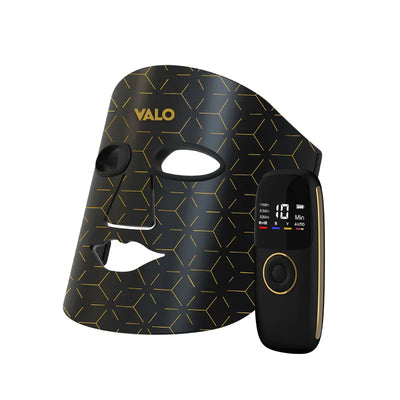
Glow Face Mask
- ✓ Blue light kills acne bacteria
- ✓ Red light reduces inflammation
- ✓ Yellow light calms redness and tone
- ✓ Also anti-aging and collagen boost
- ✓ Full face coverage, 10 min/day

Valo Beam
- ✓ Back, chest, and shoulder acne
- ✓ 300W covers large body areas
- ✓ 4 wavelengths for deep healing
- ✓ Also recovery, sleep, and energy
- ✓ Treats face + body in one device
What Acne Sufferers Are Saying
Free Clear Skin Guide
Get our clinical guide to treating acne and scarring with light therapy. Protocol, timeline, and product recommendations delivered to your inbox.
Common Questions About Light Therapy for Acne
Yes. A systematic review of 1,185 acne patients found that 92% achieved at least partial clearance of their acne lesions using visible light therapy. Blue light at 415nm destroys acne-causing bacteria, while red light at 630-660nm reduces inflammation and regulates oil production. Combined blue and red light produced an 81% reduction in lesion counts at 12 weeks in a clinical trial published in the Journal of Cosmetic and Laser Therapy.
Yes. Light therapy works through a completely different mechanism than topical products. It is safe to use alongside retinol, benzoyl peroxide, salicylic acid, niacinamide, and most prescription topicals. For best results, use the Glow Mask on clean, bare skin before applying serums or moisturizers. The light actually improves product absorption afterward.
Completely safe. Unlike benzoyl peroxide or retinol which can cause dryness, peeling, and irritation, LED light therapy has no UV radiation, no heat damage, and no chemical interaction with your skin. It is one of the only acne treatments that dermatologists recommend for sensitive and reactive skin types. Side effects are minimal and transitory (occasional mild redness that resolves within minutes).
Inflammation and redness typically improve within 1 to 2 weeks. New breakout frequency begins decreasing around week 3 to 4. Significant clearance is usually visible by week 6 to 8. Scarring and dark spot fading takes longer, typically 8 to 12 weeks. Clinical studies show the average time to partial clearance is 4 weeks. Consistency is key: 10 minutes per day, every day.
Yes. Red light at 660nm stimulates fibroblasts to produce new collagen (type I and III), which gradually fills depressed scars like ice pick and boxcar scars. For post-inflammatory hyperpigmentation (PIH) and dark spots, red and yellow light improve microcirculation and accelerate skin cell turnover, fading discoloration without bleaching agents. Most patients see scar improvement by week 8 to 12.
For facial acne: the Glow Face Mask ($299.99). It has blue light for killing bacteria, red light for inflammation, and yellow light for redness and tone. Full face coverage, 10 minutes a day. For body acne (back, chest, shoulders): the Valo Beam ($499.99). Its 300W panel covers large body areas and provides the red and near-infrared wavelengths needed for body acne and scarring.
LED light therapy is not a direct replacement for Accutane (isotretinoin) in cases of severe cystic acne. However, for mild to moderate acne, clinical studies show light therapy produces comparable results without the side effects (dry skin, depression risk, birth defect risk, monthly blood tests). Many dermatologists now recommend light therapy as a first-line treatment before considering Accutane. It is also excellent as maintenance therapy after an Accutane course to prevent relapse.
Yes. All Valo devices are FDA-cleared Class II medical devices and are HSA/FSA eligible. No prescription needed. Use Flex at checkout to pay with your health savings account. Affirm financing is also available at 0% APR starting at $25/month for the Glow Mask.
Studies Cited on This Page
Every claim is backed by peer-reviewed research. Here are the sources.
-
1Blue + Red Combination blue (415nm) and red (633nm) LED phototherapy for acne vulgaris. Goldberg, D.J. & Russell, B.A. Journal of Cosmetic and Laser Therapy, 2006. 81% mean lesion count reduction at 12 weeks. 46% reduction at 4 weeks. PubMed
-
2Blue Light Visible Light in the Treatment of Acne Vulgaris: Systematic Review. PMC, 2024. 1,185 acne cases reviewed. 92% achieved partial remission. 95% of blue light patients saw clearance. Average response time: 4 weeks. PMC
-
3Sham-Controlled Blue and red LED for mild-to-moderate acne, sham-controlled study. JAAD / Kwon et al. Inflammatory lesions decreased 77%, noninflammatory decreased 54%. No significant change in sham group. Histologic IL-1 and IL-8 reduction confirmed. PubMed
-
4Red Light RCT Comparison of Red and Infrared Low-level Laser Therapy in the Treatment of Acne Vulgaris. PMC, 2012. 630nm red light reduced lesions from 27.7 to 6.3 (77% reduction) at 10 weeks. 890nm infrared showed no significant change (confirming red spectrum as the active wavelength). PMC
-
5415nm + 633nm 7-Week Open-Label Study Evaluating 415nm/633nm Phototherapy for Mild-to-Moderate Acne. JCAD. Significant reduction in both inflammatory and noninflammatory lesions. Improved self-perception and quality of daily life. Well tolerated for home use. JCAD
-
6Light Therapies Light-based therapies in acne treatment. PMC Comprehensive Review. 630nm with ALA showed 68% clearance at 12 weeks. Low-dose ALA with 633nm LED achieved 82.1% clearance rates in multicenter trial of 397 patients. PMC
-
7Prevalence Women's acne by age. American Academy of Dermatology / Journal of the AAD. 50.9% of women in their 20s, 33% in their 30s, 25% in their 40s, 15.3% age 50+ have active acne. Adult acne incidence increased 66.6% from 1990-2021. AAD
-
8Psychological Psychosocial impact of acne. MDacne / Pierre Fabre ALL Study (2024). 96% feel depressed, 46% self-esteem issues, 31% avoid social situations, 27% feel physically avoided, 15% develop severe scarring. PubMed
Your Skin Deserves Better Than Guesswork.
FDA-cleared. Clinically proven. Zero chemicals. 60-day risk-free guarantee.
Add Glow Mask to Cart — $299.99